Radio Kapitala
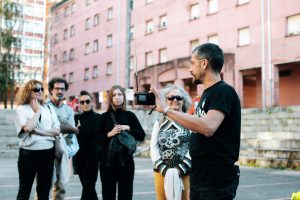
A reading of the Communist Manifesto by two retired volunteers.
The audio was broadcast on FM radio during the BAI Festival 2022 in the proletarian neighbourhood of Intxaurrondo (San Sebastián) as a tribute to the artist Agustín Ibarrola, who was arrested and tortured in 1962 for belonging to the Communist Party and for being an informant for Radio España Independiente, known as Radio Pirenaica.
Radio Kapitala is a collaborative sound work in which two anonymous voices read the entire Communist Manifesto, written by Karl Marx in 1848. The two voices belong to two retired people who frequent the pensioners’ club right in front of Ibarrola’s sculpture Las Siluetas, from where the recording of the reading is broadcast. Next to the sculpture, a small radio named “International” (after the anthem of the workers of the whole world) plays Marx’s classic text. The broadcast, imperfect, noisy and ghostly rich, invites us to think about the ghosts of the past in the present.
The Communist Manifesto begins with these words: “A spectre is haunting Europe — the spectre of communism.” While the Manifesto is more relevant than ever, the direction of that spectre has changed, if we look at the rise of fascism around the world in recent years, and not only in Europe. Today other ghosts hover over us: on the one hand, the ghost of permanent crisis (banking, real estate and energy), typical of the unregulated liberal market; on the other, the consequences of neoliberal and bourgeois policies that have, for example, turned San Sebastián into the Basque capital of the “homeless”, a city where it is almost impossible to live with dignity because of exorbitant housing prices.
In recent years, various authors and intellectuals around the world, such as the Japanese thinker Kohei Saito, have proposed a new reading of the Manifesto and of Marx’s work, in which sustainability and equality, grounded in a steady-state economy, shape the resistance against capital and lay the foundations of a future society. The communism Marx envisioned in his later years is a degrowth, egalitarian and sustainable economy.
In the Communist Manifesto, Marx writes: “In bourgeois society, therefore, the past dominates the present; in communist society, the present dominates the past.” If today it is easier to imagine the end of the world than the end of capitalism, it is worth asking from what kind of society we want to imagine what kind of future. What kind of ghost do we want to hunt down? Do we really want to be imprisoned and tortured, like Ibarrola, for belonging to a political party or for making radio? What social class do we think we belong to when, in reality, a large part of society lives on the brink of being unable to pay its energy and food bills because of recent and rising inflation, which opens up possible “homeless” futures for us in a city like San Sebastián? These questions are a call to reflection through a discreet, ghostly artwork in an essentially proletarian neighbourhood such as Intxaurrondo.
In this sense, Radio Kapitala invites us to question ourselves as individuals and as a society, and also to make radio, the very thing that landed Ibarrola in prison not so many years ago. Radio Kapitala calls for citizen participation in the same way the Communist Manifesto ends: “Working men of all countries, unite!”
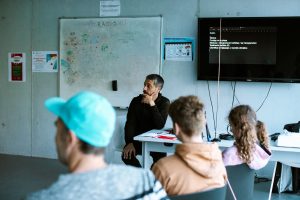
During the festival I also led a workshop related to this intervention and tribute to Agustín Ibarrola. As the sound work was made for radio, we held a radio workshop in which the participants had to imagine what the end of the world would be like, in homage to Orson Welles’ The War of the Worlds (1938), since it seems easier to imagine the end of the world than the end of capitalism. The following audio was recorded live, with no rehearsal or prior experience, with all the participants.
Context
In 1962, Agustín Ibarrola was arrested in Bilbao, tortured for 21 days and sentenced by a military court to nine years in prison. He was accused of belonging to the Communist Party and of being an informant for Radio España Independiente, known as Radio Pirenaica. He was held in Burgos prison from 1962 to 1965. He later took part in several workers’ strikes, for which he was imprisoned again from 1967 to 1973. He kept painting throughout both prison terms.
Acknowledgements
Many thanks to the two pensioners (Meri & Ángel) and to their friend Miguel, who invited them to take part, and to everyone who joined the workshop.