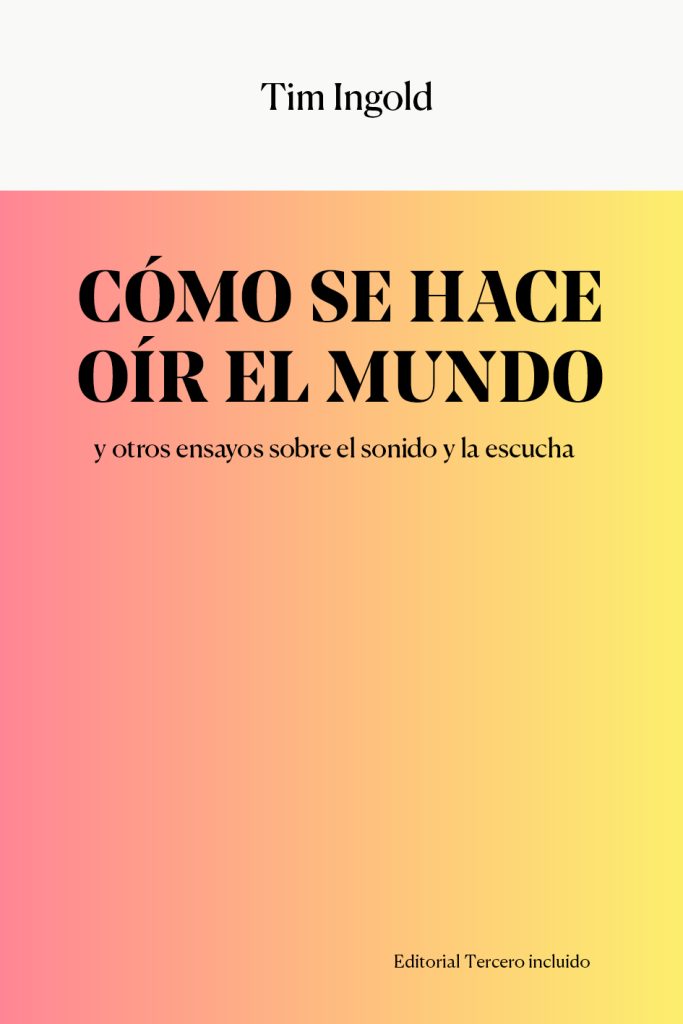
Cómo se hace oír el mundo y otros ensayos sobre el sonido y la escucha
Years ago I received an email from Carmen Pardo to tell me, among other things, that Silvio from the Tercero Incluido publishing house would write to me in case I could put him in touch with Tim Ingold. A few days later I received that email and greeted Silvio for the first time. Thank you Carmen for putting me in touch with Silvio and with Raúl and making possible everything that came after. The stories that make books possible are not found in the published pages, far from it.
This book has been made possible by that email from Carmen, by the incredible editorial work they do from Tercero Incluido and which led them to do –from my humble point of view– justice to one of the most important texts of recent decades for the sonic landscape: “Against Soundscape” by Tim Ingold.
This text, which is also known as “Four Objections to Soundscape”, had never been translated and published into Spanish, until now. It was only a matter of time before it happened and it has happened. Here it is.
After years of teaching about soundscape, finally, I will be able to refer –to anyone interested in the so-called soundscape– to a very precise translation and an edition carefully crafted down to the smallest detail. This book not only includes that now classic text which exposed the worn-out concept of soundscape but also includes other essays on sound and listening.
The years of waiting to see it in a bookstore to hold it in my hands, finally, are over. Thanks to Tim, for accepting during his retirement my insistent pleas about the relevance of this translation and edition. Many thanks to Silvio and Raúl, for the unique editorial work you do –do not stop doing it– and to Carmen for knowing how to always be there. A luxury to be able to tell all this. Enjoy this book and how the world makes itself heard.
«Language, in this sense, begins with listening. Only because we listen can the world speak to us with its own voices. Because it is in our ears, and only in ours, where these voices come to life: the creaking of trees, the howling of the wind, the roar of thunder. And it is also in our ears where they join together in chorus, urging us to respond with words and songs, clothed in the resonant languages of poetry and myth.» – Tim Ingold
What is sound? A physical impulse that travels from a source to an ear that receives it, or a sensation that exists only in the mind?
Tim Ingold, anthropologist and one of the most original voices of contemporary thought, argues that sound is not an object that is heard, but the medium in which we listen; it is not something that happens outside and that we then interpret, but an event that passes through us and in which mind and world cease to be separate.
This selection of texts, in which Ingold dialogues with authors such as John Cage, Ludwig Wittgenstein, Merleau-Ponty or Deleuze, proposes thinking our ears as vectors of attention: by lending them our listening, we give voice to things so that, in turn, they can make themselves heard.
Technical details
ISBN: 978-84-129776-7-7
Format: 120 × 180 mm
Pages: 108
Price: 10,00 €